
What a radon mitigation system actually does
Radon seeps out of the rock and soil under your foundation and drifts upward. A heated house makes this worse, because warm air rising through the building leaves a slight vacuum at the bottom that pulls soil gas in through cracks, the sump pit, and the gap where the slab meets the wall.
A mitigation system reverses that pressure difference. A fan draws continuously on the gravel layer beneath the slab, so the space under your floor sits at lower pressure than the room above it. Soil gas then takes the easy route, up the pipe and out above the roofline, rather than the hard route through your floor.
This is why the standard name for the technique is sub-slab depressurization, and why an air purifier is not a smaller version of the same thing. A purifier treats air that is already in the room. A mitigation system stops it arriving.
The parts of a radon mitigation system
A finished system has five visible components, and every one of them exists to serve that pressure difference.
- The suction point. A hole cut through the slab, usually four to six inches across, opening into the gravel or soil underneath. Crews often site it near an existing sump pit, because the pit is already an opening and sealing it is half the job.
- The pipe. Three or four inch PVC, running from the suction point up through the house or out through the rim joist and up the exterior wall. It has to discharge above the roofline and away from windows, so the gas cannot be drawn back in.
- The fan. Mounted outside the living space, in the attic or on the outside wall, never in a room you occupy. That placement is a safety rule rather than an aesthetic one: the pipe is under positive pressure downstream of the fan, so a leak there would discharge radon indoors.
- The manometer. A small U-shaped tube of coloured liquid clipped to the pipe. Uneven liquid means the fan is pulling. Level liquid means it has stopped, and that is the one part of the system you are expected to check yourself.
- The seals. The sump lid, slab cracks, and any exposed soil in a crawl space. The fan can only lower the pressure under a floor that is reasonably tight, so sealing is not cosmetic finishing work.
The fan is the part people ask about most, because it is the only piece that consumes anything. It runs continuously, adds a few dollars a month to the electricity bill, and eventually wears out. The arithmetic for your own fan is set out on the page about what radon mitigation costs in York County.
Which types actually get installed
Articles about radon mitigation usually list six or eight system types as though a homeowner were choosing between them. The record says otherwise. Across 11,470 mitigation jobs on file in York County, one approach accounts for the overwhelming majority.
Add the first three together and you have 97 percent of every system installed in the county, all of them variations on drawing from beneath the slab. The differences between them are about how the suction point is made and whether a pipe was already there, not about competing technologies.
That matters when you read a quote. A contractor proposing something exotic for an ordinary basement is proposing the rare case, and it is reasonable to ask why your house is not the standard one.
Active and passive systems
A passive system is the same pipe without a fan. Builders install them during construction under radon resistant construction practice: a gravel layer, a sheet of polyethylene over it, sealed joints, and a pipe running from under the slab up through the roof. Warm air rising inside the pipe does the work, which is cheaper but weaker.
An active system is that pipe with a fan added. In York County this is by far the most common upgrade path, and it is also the cheapest job on the board, because the expensive part is already in the ground.
Basement, crawl space and slab on grade
Nearly all York County systems are basement systems. In the mitigation record, 93.5 percent of the tests attached to an installation were taken in a basement, with first floor and slab on grade making up most of the rest.
A basement radon mitigation system is the straightforward case: there is a slab to cut and a gravel layer to draw from. A crawl space has neither, so instead of a suction point the crew lays a sealed membrane over the bare soil and draws from underneath it, which is called sub-membrane depressurization. A slab on grade house has the slab but no basement, so the pipe usually runs from the suction point out through the wall at floor level.
Houses that combine a basement with a crawl space or an addition sometimes need two suction points, and that is the single most common legitimate reason for a quote above the county norm.
What a radon mitigation system looks like
From outside, most systems read as a white plastic pipe running up the side of the house, roughly the diameter of a downspout, ending above the gutter line with a small fan housing part way up. Some crews route the pipe inside the house through a closet or the garage so only the roof penetration shows, which costs more and is worth asking about if the exterior matters to you.
Inside, you will see the pipe entering the floor, a sealed sump lid if there is a sump, and the manometer clipped to the pipe at eye level. There should also be a label giving the installer, the date and the certification number, because Pennsylvania requires the system to identify who installed it.
A system is not supposed to be silent, but it should be unobtrusive. A noticeable hum in a living space usually means the fan has been mounted somewhere it should not be.
How well each type works
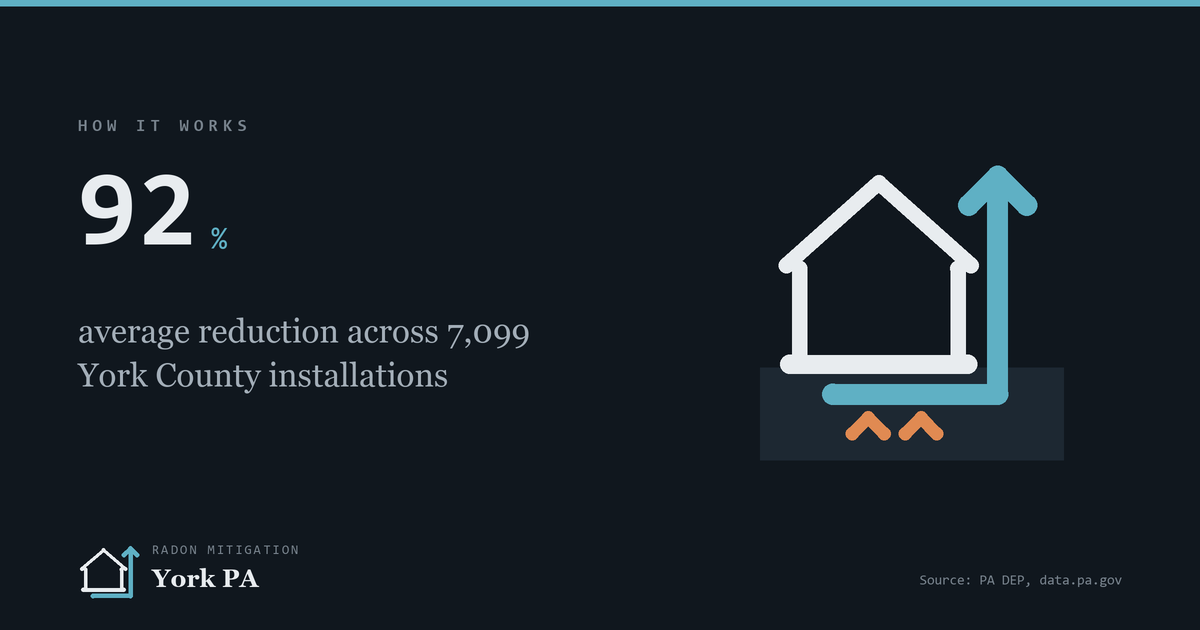
The state register records a reading before mitigation and after it, which makes this measurable rather than a claim. Across 7,099 York County installations with both readings on file, every approach performs, and the differences between them are small.
| System type | Pairs | Before | After | Cut | Below 4 |
|---|---|---|---|---|---|
| Sub-slab ventilation | 5,480 | 22.8 | 1.50 | 93.4% | 97.9% |
| Sub-slab pit cut-out | 897 | 23.8 | 1.24 | 94.8% | 98.2% |
| Activating a passive pipe | 602 | 22.9 | 1.15 | 95.0% | 98.8% |
| Passive depressurization | 65 | 20.6 | 0.91 | 95.6% | 100% |
| Slab-on-grade | 55 | 12.3 | 1.27 | 89.7% | 100% |
The headline is that the cheapest job is not the weakest one. Activating an existing passive pipe cut radon by 95.0 percent and left 98.8 percent of houses below the action level, which is at least as good as building a system from scratch. The reason is simple: a passive pipe was placed during construction, so it sits in a properly prepared gravel layer.
Read the last two rows with their sample sizes in view. Sixty five and fifty five installations are enough to show the approach works and not enough to rank it against the others.
What happens on installation day
- The crew picks the suction point. Usually one, sited for a short pipe run and a fan position away from where you sit.
- They cut the slab and clear a void underneath. This is the loud part and it is over within the hour.
- Pipe goes in and up. Out through the rim joist and up the exterior, or internally to the roofline.
- The fan is mounted and wired. Attic or outside wall, on its own circuit, never inside the living space.
- Openings get sealed. Sump lid, visible slab cracks, and the slab to wall joint.
- A post-mitigation test confirms it worked. This runs after the system has had time to draw down, so the result arrives a few days later rather than the same afternoon.
Whether any of this is a job you could take on yourself is covered separately, including the two steps that go wrong most often, on the page about DIY radon mitigation.
Most single family installations are done within a day. The step to insist on is the last one, because it is the only part that turns the work into a measured result, and it is the reason the figures on this page exist at all.
For who can legally do this work in Pennsylvania, see the list of radon contractors working in York County.
Common questions about radon mitigation systems
What is a radon mitigation system?
A pipe and fan that draw soil gas from beneath the floor slab and discharge it above the roofline. The fan keeps the space under the slab at lower pressure than the room above, so radon takes the pipe instead of entering the house.
How does a radon mitigation system work?
By reversing a pressure difference rather than filtering anything. A heated house pulls soil gas in through cracks and the sump pit, and a continuously running fan under the slab takes that pull away.
Do radon mitigation systems actually work?
Across 7,099 York County installations with a reading before and after, levels fell by between 89.7 and 95.6 percent depending on type. At least 97.9 percent of houses finished below the 4 pCi/L action level whichever approach was used.
What does a radon mitigation system look like?
From outside, a white PVC pipe about the width of a downspout running up the wall past the gutter, with a small fan housing part way up. Inside, the pipe entering the floor, a sealed sump lid, and a liquid filled manometer clipped to the pipe.
Does the radon fan have to run all the time?
The fan maintains the pressure difference that keeps soil gas out, so switching it off returns the house to where it started within days. Check the manometer occasionally: uneven liquid means the fan is pulling, level liquid means it has stopped.
What is the difference between an active and a passive radon system?
A passive system is the same pipe without a fan, relying on warm air rising to move the gas. An active system adds the fan. Passive pipes are fitted during construction and upgrading one is the cheapest job in the county record.